
Glossary
Container glossary
The terms you'll meet when buying, renting or converting a container — explained in plain language.
No matching terms.
Sizes & types
- 20ft container
A standard container 20 feet long (about 6.06 m), about 2.44 m wide and 2.59 m high. Inside it measures about 5.90 × 2.35 × 2.39 m, roughly 13.9 m² of floor space. The most popular size for offices, small warehouses and booths.
- 40ft container
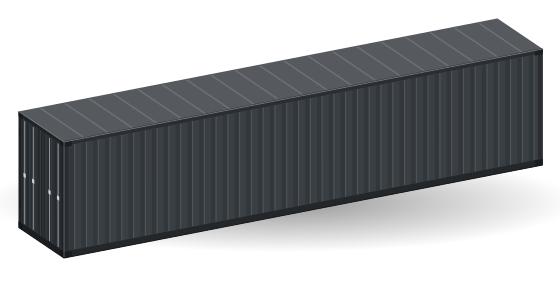
A container 40 feet long (about 12.19 m) with the same width and height as a 20ft unit. Its floor area of about 28 m² fits an office with a meeting room, worker accommodation or a large warehouse.
- 10ft container
A short container about 2.99 m long, typically used for guard posts, small booths or mini storage. Easy to move and fits on tight plots.
- High cube (HC)
A container one foot (about 30 cm) taller than standard: about 2.90 m high outside and 2.70 m inside, usually in the 40ft size. More headroom for ceilings, air conditioning and tall racking.
- TEU
Twenty-foot Equivalent Unit — a unit of cargo capacity equal to one 20ft container. A 40ft container counts as 2 TEU. Used in shipping and ports, e.g. "a 5,000 TEU vessel".
- Dry container (GP)
The ordinary enclosed, general-purpose container for dry goods. This is the type most often converted into offices, warehouses and living spaces.
- Reefer
A refrigerated container with insulated walls and its own cooling unit, for frozen or fresh cargo. Used reefers are often turned into cold storage.
- Open top
A container without a steel roof (covered by a tarpaulin) for cargo that is too tall and must be loaded from above by crane.
- Flat rack
A container made of a floor with end walls but no side walls or roof, for oversized cargo such as machinery and heavy equipment.
- Open side
A container with wide doors along its long side so the whole side can open. Handy for booths, kiosks or warehouses with frequent loading.
Condition & standards
- One trip
A new container that has made only one voyage, usually from the factory to the destination country. It is in near-new condition: clean paint with minimal dents and rust.
- Grade A / B / C
Sellers' terms for the condition of used containers — not an official standard, so always ask for photos or inspect the unit. Typically: A = minimal dents and rust, B = some dents or light rust but a sound structure, C = more damage, fine for basic storage.
- Cargo worthy (CW)
A used container certified fit to carry sea cargo: its structure, floor and doors still meet safety requirements.
- Wind & water tight (WWT)
A used container that keeps out wind and water (no leaks). Fine for storage on land, but not necessarily fit for sea shipping.
- CSC plate
A metal plate on the container door showing its safety approval under the Convention for Safe Containers, including the manufacturing date, maximum weight and stacking capacity.
- ISO 668
The international standard for the outside dimensions and weight ratings of freight containers, so containers from any factory fit the same trucks, trains and ships.
Structure & parts
- Corten steel
Weathering steel used for container walls. A thin, stable rust layer on its surface protects the steel from deeper corrosion; good paint is still needed for appearance.
- Corrugated walls
Ribbed steel walls that make a container strong despite thin plates. When cut for doors or windows, openings get a reinforcing steel frame.
- Corner casting
Hollow steel blocks at all eight corners of a container: the points for lifting by crane, securing to a trailer and stacking.
- Twistlock
A lock inserted into a corner casting and turned, to fix a container to a trailer or to another container when stacked.
- Forklift pockets
Two slots in the base of a container (usually 20ft) for forklift tines, so the unit can be lifted without a crane.
- Cross members
Steel beams running across under the floor that support the floor and the load on it.
- Marine plywood floor
The original container floor of thick, treated plywood (usually about 28 mm). In converted containers it is usually covered with vinyl, parquet or tiles.
- Locking bars
Vertical bars on the container doors, turned with a handle to close the doors tightly.
Interior, power & AC
- Sandwich panel
A wall or roof panel with an insulating core (EPS, PU or rock wool) between two metal sheets. It blocks heat and noise and is quick to install.
- Glass wool / rock wool
Fibrous insulation for container walls and ceilings. It keeps the sun's heat out, so the room stays cooler and the AC uses less power.
- PK (AC capacity)
The common way to state air-conditioner capacity in Indonesia (from the Dutch for horsepower). Roughly ½ PK ≈ 5,000 BTU/h, 1 PK ≈ 9,000 BTU/h and 2 PK ≈ 18,000 BTU/h.
- BTU/h
British Thermal Units per hour — the measure of how much heat an air conditioner removes. The larger and hotter the room, the more BTU it needs.
- VA (grid connection)
Volt-amperes, the unit of the power capacity supplied by the grid (PLN), e.g. 2,200 VA. It must exceed the total load of appliances running at the same time.
- kVA (generator)
Generator capacity in kilovolt-amperes (1 kVA = 1,000 VA). Choose a generator with a margin so it copes when the AC or a pump starts up.
- MCB
Miniature Circuit Breaker — a safety switch that cuts the power automatically on overload or short circuit. Installed in the container's electrical panel.
- Grounding (earthing)
A conductor that carries leakage current safely into the ground. Essential for containers because the whole body is conductive steel.
Delivery & rental
- Mobilization & demobilization
Mobilization is delivering the container to the site; demobilization is collecting it again when the rental ends.
- Crane truck (self loader)
A truck with its own crane that can unload and place a container without a separate crane — as long as there is enough road access and working space.
- Pedestals (container foundations)
Concrete or steel supports under the container corners that keep the unit level, off the bare ground and clear of standing water.
- Rental deposit
A security amount paid at the start of the rental and refunded after the unit is inspected at pick-up.
- Tare, payload & max gross
Tare is the empty container weight (20ft about 2.2 t, 40ft about 3.7 t), payload is the maximum cargo weight, and max gross is tare + payload. All three are marked on the container door.
More tools
- Delivery costContainer delivery cost to your city & estimated delivery time.
- AC calculatorThe right air-conditioner size for your container.
- Power & generatorTotal load, recommended grid connection and generator size.
- Container vs brickCompare the cost and build time of a container with a brick building.